
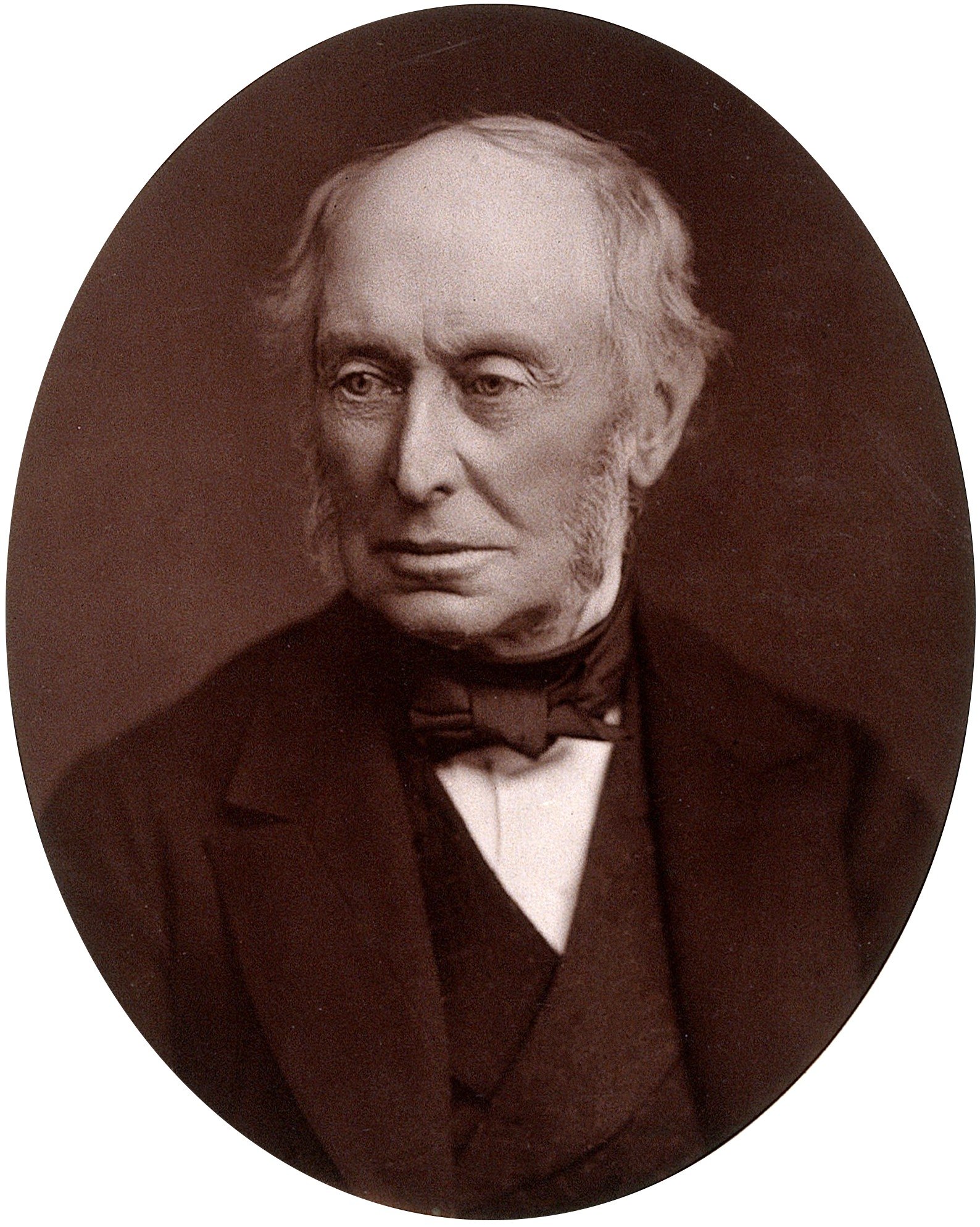
In this blog post, we take a look at one of the many unsung heroes that made Underfall Yard – and the Floating Harbour – a maritime marvel over the past 200 years. William Armstrong and his innovation in hydraulic power made Bristol’s City Docks a commercial success and influenced the look of the harbour today.
Ask people to name someone who made a significant contribution to the development of Bristol’s Floating Harbour and, hopefully, some would mention William Jessop. In the early 1800s, he was the architect of the overall Floating Harbour scheme.
Many would probably mention Isambard Kingdom Brunel (IKB), though he wasn’t even born when construction of the harbour started. In the 1840s, he improved the sluices, re-designed the Southern Entrance Lock, addressed mitigation of the persistent silting problem, and engineered ‘Brunel’s Other Bridge’.
But there is another largely unsung hero, whose ingenuity and inventiveness made the 1870s upgrade of the harbour facilities a practical proposition – William Armstrong.
When the floating harbour was constructed 1804 > 1809, electricity had barely been discovered, the internal combustion engine had not been invented, and steam engine technology was in its infancy. There was no way to operate lock gates, sluices, cranes, etc., except by man-power aided by a horse or two. The principles of hydraulic power were understood, but there was no substantive industry producing hydraulic machinery.
Dock operations coped with manual operation.
In the 1840s the Docks Company finally got around to reconstructing and widening the deteriorating Southern Entrance Lock, to a novel IKB design which replaced pairs of lock gates with much wider single gates. IKB realised they would benefit from being powered, and investigated the adoption of hydraulic power using groundwater pressure from local springs. He concluded that local pressures were too low to make hydraulic power effective, and dropped the idea.
Meanwhile, much further north in Newcastle, in his spare time a young solicitor named William Armstrong applied his natural curiosity and inventiveness to the development of hydro-electrics and a piston engine driven by water pressure. He designed a hydraulic quayside crane which proved to be a great success on Newcastle’s quays.
In 1847 he quit the legal profession and established W G Armstrong and Co. at Elswick, near Newcastle, manufacturing cranes and other hydraulic equipment. The firm went on to become one of the ‘giants’ of British manufacturing.
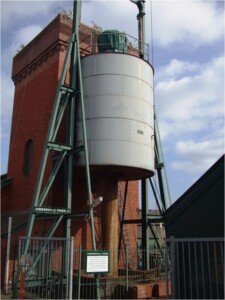
Hydraulic power is directly related to water pressure, and up to the 1840s water pressure was dependent on groundwater springs or water towers (analogous to the pressure of water emerging from a domestic cold tap). In 1849, in the quest for higher water pressure to deliver more hydraulic power, William Armstrong invented the raised weight / moving-mass accumulator. Almost overnight it became possible to achieve a working pressure of 750 psi (52 bar) up from a previous maximum of c. 100 psi. Unfortunately for IKB, the invention was just one year too late to influence his decision regarding powering the new entrance lock gates.
We jump now to the 1870s. The much larger Howard’s Entrance Lock and associated new Junction Lock were constructed. They were of a size that demanded powered operation, and so a Pump House was built adjacent to the Junction Lock, housing a W G Armstrong and Co. steam engine/pump, a moving-mass accumulator, and associated coal-fired boiler. Underground pipes fed the high-pressure water supply to the Entrance and Junction Locks and to ‘Brunel’s Other Bridge’, where W G Armstrong and Co. hydraulic machinery powered the gates, sluices, and bridge swings.
This initial adoption of hydraulic power in the Docks was relatively successful, and led to a major expansion of the system. At its hight, the system was used to power lock gates, sluices, capstans, swing-bridges, cranes, the Patent Slip, granary elevators and a tobacco press. W G Armstrong and Co. hydraulic machinery was extensively used throughout.
One can only speculate as to how the docks would have operated without the benefit of William Armstrong’s inventiveness.
The Armstrong name lived on through a series of industrial mergers and acquisitions. William is the ‘Armstrong’ in
- Armstrong, Mitchell & Co
- Armstrong, Whitworth & Co
- Vickers-Armstrong Ltd
- Armstrong Siddeley
Engineering aside –
- In 1830 he submitted a proposal for bridging the Avon at Clifton with a single-span girder and supporting masonry viaducts, losing out to IKB.
- He became a Fellow of the Royal Society in 1846.
- He was knighted in 1859.
- In 1879 he was presented with the Albert Medal by the Society of Arts “because of his distinction as an engineer and … because by the development of the transmission of power – hydraulically – the manufactures of this Country have been greatly aided …”
- He was raised to the peerage in 1887.
- Between 1862 and 1895 he built and further developed Cragside in Northumberland, which became the family home, now owned by the National Trust

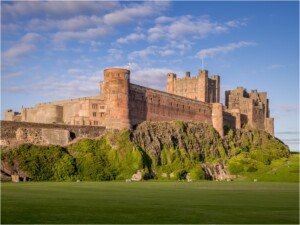
- In 1894 he bought and later restored Bamburgh Castle in Northumberland. Open to the public, it remains in his family’s ownership and incorporates The Armstrong and Aviation Museum.#
Thank you to our writing volunteer, Pete Farmer, for this amazing piece of research.