
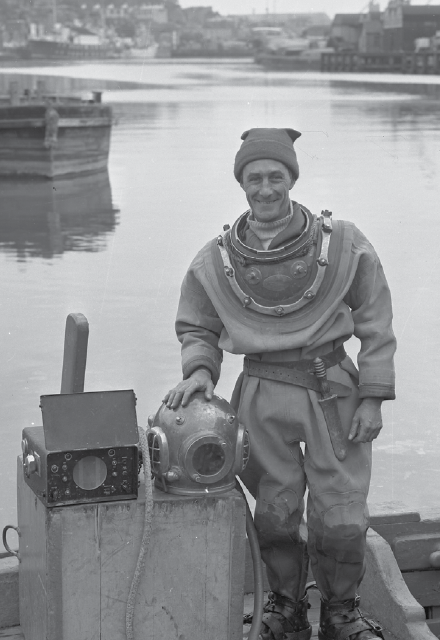
Read part 1 of our deep dive into Bob Broome’s diary here: https://underfallyard.co.uk/2025/10/28/the-diary-of-a-bristol-diver-bob-broome/
When Bristol diver Bob Broome began work as a Port of Bristol Authority diver, the City Docks were still a working port. With the advent of container ships, this could not last, and in 1969, Bristol City Council announced plans to close them. What would this mean for the future of the Floating Harbour? Should it be filled in to make way for a road system, as one plan recommended[1], or developed for leisure use? How much of the harbour infrastructure would be preserved, and how would this affect the role of the “hard hat” diver?
As Bob’s diaries[2] record, many aspects of his work did not change. Lock gates still needed repairing, sometimes urgently. In January 1965, he wrote “Cumberland Basin, broken chain. Called out 12.15am. Nice night. North outer gate. Finished 6am.” The following year, he took a boat under the Centre to clear the stop gates on the underground River Frome. These gates, at the site of the old Stone Bridge, (near the Cenotaph) prevent flood water entering the harbour.
He sometimes had to improvise. To clear stones from the lock gates at Netham, he “had a right-angled shovel made and attached to 16-foot pole” which did the job. Things did not always go according to plan. In 1977, one of the granite columns supporting Bristol Bridge was damaged by a barge. Attempts to jack it back into place failed. “50 ton on the jack, no movement. Job put off for another think.”
The diver was often needed to retrieve foreign objects from the dock. These included fallen trees, sunken vessels, a dead cow, a hogshead of tobacco, a Vespa scooter and a barrel of Guinness. On one occasion, he rescued a waterlogged swan from the patent slip and put it in the workshop to dry out before calling the RSPCA.
On the evening of 27th March 1968, a lorry driver returned from his tea break to find that the cab of the articulated lorry he had left parked on the quayside had plunged into Bathurst Basin. Bob and the dive crew attached chains from the submerged cab to the 25-ton crane, which was called up from Avonmouth to haul it out. Bob and the crane were needed again the following year, to rescue a forklift truck from the dock near V shed on St Augustine’s Reach. This is an unlucky spot. It was near here in 2021, during filming of Stephan Merchant’s production “The Outlaws”, that a costume truck reversed into the harbour.[3]
One of Bob’s responsibilities was maintaining and operating the patent slip at Underfall Yard, clearing mud from the track and servicing the slipway cradle. In 1968, the council dredger BD5 was on the slip when the cradle failed. The tug John King had to tow the cradle and BD5 back into the water. The same thing happened a few years later when attempting to “undock” a barge “Had great difficulty in moving cradle down slip at all.” After three hours and several broken ropes, the barge was still only half in the water. It was finally towed off by a tug belonging to its owners. Divers examined the slip but “could find only mud.”
One sign of change affecting Bob’s work happened in June 1971. Pressure groups opposing the closure of the Floating Harbour organised a Water Festival to highlight its value as a community asset. In preparation, Bob worked on constructing a slipway at the Nova Scotia, building a coffer dam, pumping it out to provide a dry working area and laying hardcore. The Water Festival was a success and developed into the present-day Harbour Festival. It began a move towards management of the harbour for leisure activities.
On 23 November 1971, Bob took a tour “round the Bristol Docks as far as Totterdown Basin and back to Underfall Yard with Sir Hugh Casson in ML (Motor Launch) Mardyke.” Casson, the Festival of Britain architect, was commissioned by the Council to produce a scheme for redeveloping the docks. His report[4] favoured leisure use and the preservation of architectural character. It was largely through his influence that E Shed (now The Watershed) was saved from demolition for road widening.
In 1972, power boat racing came to the Floating Harbour, drawing spectators in their tens of thousands. In preparation, Bob cleared flotsam and jetsam and moved temporary slipways into place. Before the 1977 event, he had a more unusual task. “26 May. Worked to 9pm building sandbag wall round swan’s nest at Gas Ferry.”
Bob’s diaries from the 1970s and ‘80s record the slow dismantling of the working life of the docks. Equipment and some of the workforce, including divers, were transferred to Avonmouth. In November 1972, Bob oversaw the removal for scrap of the cranes on Wapping Wharf. On 13th February 1977, he wrote “(the fireboat) Pyronaut departed for Avonmouth on AM tide under own power.” In 1981 he recorded “meeting in mess room, all hands. Reps from PBA and Corporation to explain transfer of Underfall Yard men to Bristol Corporation in the New Year.” This was the end of the Port of Bristol Authority’s involvement with the City Docks.
Bob’s last diary dates from 1983. He retired shortly after, having witnessed nearly forty years of changing fortunes in the Bristol docks.
[1] Bristol Civic News Aug 1969 Bristol Archives 43873/2
[2] Bristol Archives 45717/1/1-23
[3] BBC News website 21 Oct 2021
[4] Bristol City Docks Redevelopment Study 1972, “The Casson Report”
A big thank you to our writing volunteer Elaine for her research into this fascinating story.