
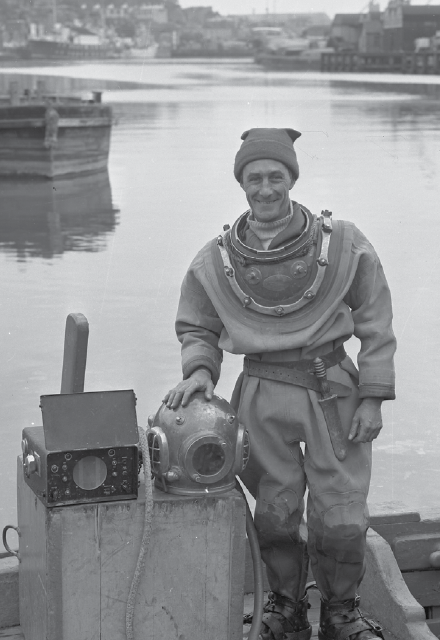
For nearly forty years, Bristol diver Robert “Bob” Broome worked for the Port of Bristol Authority. His working life spanned a period from post-war recovery to the closure of the City Docks and the start of regeneration of the harbour. For most of that time, he kept a diary detailing his varied and sometimes dangerous work. Those diaries are now in the Bristol Archives collection and form the basis of this blog.[1]
After working as a shipwright at Charles Hill’s shipyard, Bob trained as a diver at the naval dockyard in Gibraltar during World War 2. On his return to Bristol, he took up his post with the PBA, exchanging the clear waters of the Mediterranean for the murky depths of the Floating Harbour. Wearing the Standard Diving Dress of a rubberised suit, copper helmet and weighted boots, Bob worked in conditions so muddy that he was, as he put it, “diving in the dark.”[2] He was supported by two men on the diving boat who controlled his air supply, and with whom he could communicate via a telephone line from his helmet. He used specialised equipment to enable him to carry out highly skilled underwater drilling and welding.
Bob’s diaries begin in 1947. Bristol was still suffering from the effects of the war years, during which little had been spent on the port infrastructure. The first task he recorded was a huge and significant one: replacing the 75-year-old Entrance Lock gates at Cumberland Basin. On the morning tide of 11th January 1947, the first outer gate was floated into position. Bob wrote, “Followed the heel of the gate down to the quoin and onto the pintle.” The quoin was the housing of the 70-ton gate and the pintle was the bearing on which it would turn.
The second lock gate was launched on 24th January. By this time, the country was in the grip of a spell of bitterly cold weather which was to make the winter of 1947 notorious. Bob was called to Cumberland Basin on the morning of 7th February to test the closure of the new gates. He recorded “everything covered in ice.” “Air valve froze up twice while descending. Had to have hot water poured over the valve to free it.”
Work on replacing the inner gates began in March. A newspaper article described Bob emerging from the lock “so thickly clothed with Avon mud that he had to be sluiced down with water before the diving kit became recognisable.”[3] On 28th April he started work at 6am, attempting to remove an old bearing. Conditions were so muddy that he was forced to stop and call for Cumberland Basin to be scoured. There was a long delay, as the scour can only take place at low tide. After six hours of diving time, he finally clocked off at 11.30pm and took a taxi home, which, he tersely recorded, he “charged to PBA, 9 shillings.”
On 18th July, the huge task was completed with the fitting of a gate at the Junction Lock. Bob wrote, “The last of the lock gates. Watched [the] launch of the last leaf. Went off very nicely indeed.” Unfortunately, the first attempt to “step” the gate failed, and it had to be refloated and repositioned, “holding up shipping for half an hour.”
This last comment highlights one of the challenges for a diver in a busy commercial harbour. His schedule was dictated by the movements of dock traffic. “Working to the tides” was a constraint of the job. In 1949, struggling to clear an obstruction from the Underfall culverts, Bob had no time to call for safety equipment “as the flood [was] upon us.” Trying to remove the bearing from the bottom of a lock gate (“very hard work”), he wrote, “Nearly had the pintle out but the tide beat us.” Occasionally, insufficient depth of water meant that a job had to be “put off to a better tide.”
The diver was also at the mercy of the weather. In January 1962, when the harbour was covered with an inch-thick layer of ice, Bob once again found his valve chest and air pipes frozen. On 11th July 1968, he recorded “No diving. On flood standby all day. Finished at 10.30pm.” On the morning tide, the water had overtopped the quay walls at Underfall Yard. This was what became known as the Great Storm, in which two months’ worth of rain fell in two days, leaving large parts of the city underwater.[4]
Bob’s work for the PBA extended to Avonmouth on occasion. In January 1962, he was called out to an emergency at the Royal Edward Dock. A storm had blown the roof of a shed into the lock, jamming the gates. Bob first cleared the area using an air lift pump, which “made the mud fly out.” Then a 30-ton floating crane lowered a limpet dam into place. This was a watertight cage which allowed essential repairs to be carried out safely below water level. It took five days of intensive work, going on into the night, to clear the obstruction and repair the gate.
The late 1960s marked a watershed in Bob’s career. It was clear that the City Docks had no future as a commercial port. Yet even if they closed to trade, the infrastructure still had to be maintained. Although some aspects of his job would remain the same (mud, weather, obstructions in the locks), the end of commercial shipping and the regeneration of the harbour as a leisure facility would bring changes for Bob and the dive crew.
[1] Bristol Archives 45717/1/1-23
[2] Bristol Evening Post 13 September 1954
[3] Western Daily Press 25 April 1947
[4] Bristol Evening Post 12 July 1968
A big thank you to our writing volunteer Elaine for her research into this fascinating story. Stay tuned for part two and how Bob’s career changed following the closure of the City Docks…