
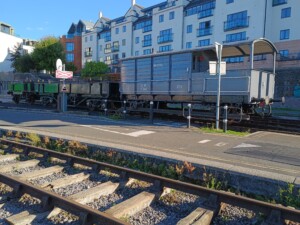
 This weekend (4-5th October) we celebrate Docks Heritage Weekend, with Underfall Yard, M Shed and SS Great Britain offering unique activities to explore the working history of the Floating Harbour. Visitors will be able to travel between venues by ferry or heritage bus. But you can also spot another crucial piece of working docks as you enjoy the harbourside walk: the Bristol Harbour Railway. Volunteer Anne-Marie Shepherd has been researching the story of the railway, and how it connected Underfall Yard to the rest of the docks…
Bristol has a long maritime history and the City Docks (also known as the Floating Harbour), have helped to bring much prosperity and wealth to the city and its people. Before 1809, the whole of the Bristol Channel, including the City Docks area, was subject to its tidal range, which is the second highest in the world. This resulted in many ships falling over, which meant all the contents of the ship had to be properly stowed away and fastened. This gave rise to the phrase “ship-shape and Bristol fashion” when tidying an area. In 1809, the Floating Harbour in the city was created so the ships did not become stuck. This saved time, money and increased productivity. The next major issue that had to be solved was moving the merchandise between the ships at the City Docks and the trains at Temple Meads train station. This was due to delays and additional costs as a result of having to move merchandise by horse and cart between the City Docks and Bristol Temple Meads train station, then transferring the trucks to the higher level of Bristol Temple Meads train station. This resulted in losses to the Port of Bristol, as companies chose to go to other ports.
The first idea that was put into action of linking the City Docks to the train station came from the Bristol and North Somerset Railway Company. They wanted to be able to bring the coal being mined in and around Radstock in North Somerset to Bristol, but by creating a tramway. Despite obtaining an Act of Parliament which authorised the company to start this endeavour, as well as organising two opening ceremonies (one just outside of Radstock in the village of Clutton and the other at Bristol’s Floating Harbour), they never succeeded in completing the project. This was due to running into numerous issues and a lack of money, and it eventually pulled out of the project by 1871.
This cleared the way for the Great Western Railway (GWR), the Bristol and Exeter Railway and the Bristol Corporation to fully take over this project. They had formed a partnership, and the parliamentary bill they had been backing, which outlined plans for a harbour railway, gained Royal Assent a few years previously in 1866 and had begun building a rail line from this period. The Bristol Harbour Railway opened in early 1872 and ran from Bristol Temple Meads train station to the east side of Prince Street. The Bristol Harbour Railway was extended to the Princes and Wapping Wharves and was now wholly owned by the Great Western Railway.
Interestingly, around this time, improvements were taking place further down the Floating Harbour close to Underfall Yard. Thomas Howard, the Bristol Dock Works resident engineer and Superintendent, was in charge of the new lock system improvements at Cumberland Basin from 1872 to 1873. The development is called the North Entrance, or Howard’s Lock, and involved adapting and moving Brunel’s swing bridge and other modifications. This included making the area larger for the bigger ships to be able to pass through and adding hydraulic machinery to operate the sluices and gates (the power for this new equipment coming from the 1871 pump house). The aim of the improvements was to give the Bristol Docks a more competitive edge. This could be seen as working hand in hand with the Bristol Harbour Railway, which was now officially up and running, as lacking both had been major drawbacks and caused the Floating Harbour to lose business.
The opening of the Ashton Swing bridge in 1906, which had train tracks on the bottom and a road above, meant that a train could travel much farther along the Bristol City docks, all the way from where M Shed is located, running along the New Cut on Spike Island and passing behind the Underfall Yard.
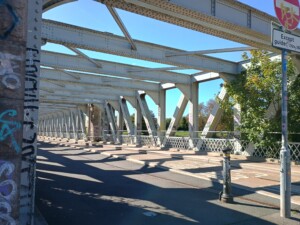
Ashton Swing Bridge in 2025
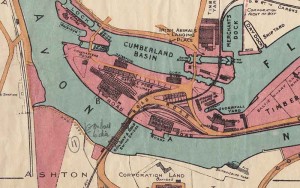
Map of the City Docks c.1920, showing Underfall Yard and the route of the railway
A map from c.1920 shows the Ashton Swing bridge (which was one of the three bridges powered by the hydraulic equipment at Underfall Yard), shows the rail track coming off the bridge onto Spike Island and then splitting into two. One line goes around to the right behind the Underfall Yard, along the New Cut and then goes to the other side of the island where the Bristol Docks are located, including where M Shed is now, and then onto Bristol Temple Meads. The other line bears to the left, cutting through Avon Crescent (which is now used as an entrance to Underfall Yard) and past the Cumberland Basin lock system. The map then shows the path of the train tracks going close next to the Merchants Docks, and near the cattle pens and the Irish Animals Landing Place built along the Cumberland Basin.
Ashton Swing Bridge was used as a rail bridge up until the 1980s, and has more recently become a popular cycle and walking route. Unfortunately, it gradually fell into disrepair until it was decided it would become part of a new Metro bus route in the twenty-first century. It was completely closed for just over a year and partially opened in 2017 as a cycle and walking route, The other half of the bridge was created into the bus route for the M2 bus, which is the bus that stops nearest to Underfall Yard.
The M Shed has working exhibits which includes a train ride pulled by the steam locomotive Henbury. It currently has one route from M Shed up to I.K. Brunel’s ship, the SS Great Britain. There used to be a second route that initially went along next to the Floating Harbour, just as the current route, but then veered off to the left and went to the New Cut. It followed next to the New Cut up to the old red brick Tobacco warehouse, one of which holds documents for the Bristol Archives and the other houses the Create Centre and Bristol Archives. The stop was also a short stroll to Underfall Yard. Unfortunately, in early 2020, as a result of subsidence, a section of the track and path fell into the New Cut. It is hoped that this will be restored and M Shed will be able to once again run this second line. At the moment, the Vauxhall bridge (which was another of the three swing bridges that Underfall Yard’s Hydraulic equipment powered) is currently being renovated, and the scaffolding is partially on the route of the railway track.
This article was researched and written by Anne-Marie Shepherd and reviewed by Underfall Yard Trust. Anne-Marie would like to thank Dave Blackburn, a volunteer for M Shed and Underfall Yard, for his wealth of knowledge on the Bristol Harbour Railway.
Docks Heritage Weekend takes place this weekend, 4-5th October, at Underfall Yard, M Shed and the SS Great Britain. Family activities and demonstrations are open 11am-4pm on both days. We hope to see you there!