
Serving the boats of Bristol’s Floating Harbour since 1854, the patent slipway never fails to draw the eye of visitors to Underfall Yard. In this month’s blog, volunteer writer Elaine delves into its origin story…
“On Monday last a first trial was made of the heaving-up slip which has recently been erected by three enterprising citizens on the banks of the Floating Harbour” the Bristol Mercury reported in April 1854.
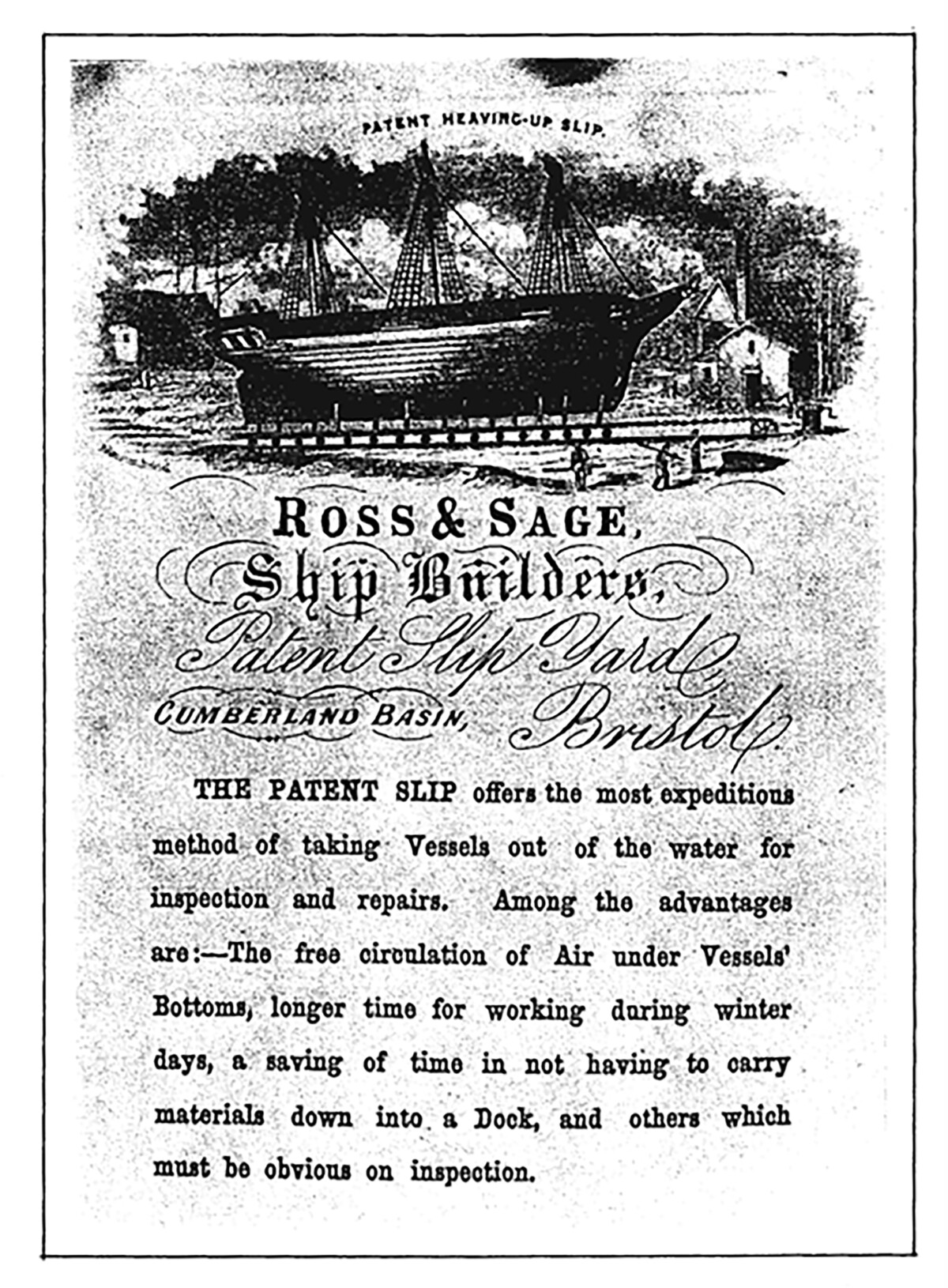
An advertisement for Ross and Sage’s original slipway (Bristol Museums and Galleries)
The three enterprising citizens were William Ross, a shipbuilder from Devon, his son William Labdon Ross, and his son-in-law Joseph Sage. They leased Nova Scotia Yard (the former name for the area around the Visitor Centre and Cafe), until 1864. The patent slip they installed, though several times rebuilt, is essentially the same heave-up slip that is still in operation at Underfall Yard.
This type of slipway was patented in 1819 by Thomas Morton, a shipbuilder of Leith, Scotland. It consists of an inclined plane, down which a timber cradle is lowered into the water on fixed metal rails. The vessel is floated onto the cradle, which is then pulled out of the water. The design was popular among small shipbuilders as a cheap alternative to a dry dock for repairing and maintaining boats.
Following Ross and Sage, several other small shipbuilders worked at Nova Scotia Yard. In July 1880 the tenant, Mr Nurse of Clifton, launched his new steamer from the slip. The yard was open to the public for the occasion.
The following year, the Docks Committee bought Nova Scotia Yard and amalgamated it with the existing Underfall Yard. Docks Engineer Thomas Howard entered into negotiations to buy the patent slip from Mr Nurse. It was evidently not in the best condition. “The Engine and Boilers I consider not worth having at any price beyond old iron. The slip would be of use for heaving up our barges, hoppers, dredges, lock gates, &c.” After some haggling, Howard bought the slip for £150.
The Docks Committee used it for maintenance of their own vessels, and also earned revenue from it “by lease to outside traders.” Howard’s successor, John Ward Girdlestone, overhauled the slip in1890. By this time, hydraulic power had been introduced to the Yard. The slip was powered from the hydraulic engine house until it was provided with its own electric motor in 1924. The motor and winding gear can be seen in the winch shed at the head of the slipway.

Young visitors by the restored patent slipway
With the decline of the Floating Harbour in the 1970s, the patent slip fell out of use. When it was damaged by a dredger, it was not thought worth repairing. By the late 80s trees were growing from it. The Underfall Yard Trust recognised the historical importance of the slip and saved it from dereliction in the 1990s. The timber cradle was completely rebuilt, and the slip was once again able to receive vessels for repair.
Records show that the cradle has been rebuilt approximately every 30-40 years. This was last done in 2022. The timber used was greenheart, a hardwood from Guyana, chosen because it is dense and does not float. Some of the metal parts were replaced at the same time. They were cast using the historic wooden patterns made in Underfall Yard’s Patternmakers’ workshop.
After 170 years, the patent slip is still providing a valuable service. Visitors to Underfall Yard can see a changing cast of vessels on the slip, including working and leisure craft as well as historic vessels such as John King and the Matthew.
This article was researched and written by volunteer writer Elaine Clark, and reviewed by Underfall Yard Trust. To read more about the restoration project in 2022, take a look at the previous articles by volunteer writer Andrew Radford. For further information on the sources for this article, please get in touch at info@underfallyard.co.uk.
The Recovery and Reinstatement Project is now underway after the fire in May 2023. Click here to read more and find out how to support the project…